Páginas

miércoles, 20 de junio de 2012

Dia de La Bandera Argentina / Argentina's Flag Day


Hoy en Argentina conmemoramos el día de nuestra bandera, la celeste y blanca. Queremos compartir con todos los Argentinos que visiten esta página, este día especial. Y quienes son extranjeros que sepan que hoy es el día de nuestra bandera. Esperamos que hayan disfrutado de este día y que sigamos conmemorando este hermoso país y bandera. 


Today it s Argentina's Flag Day, the light blue and white. We want to share with all the Argentinians that visit this blog this special day. And for those who are foreigners to let you know that is our flag's day. We hope you have enjoyed this day and that we continue celebrating of this beautiful country and flag. 


Saludos, Perle.

Your Faithfully, Perle.

martes, 19 de junio de 2012

Algunos de Nuestros Productos / Some of Our Products II


Carteras hechas con Aplicados/Handbags made with appliqués. 


Antes que nada, ¡Bienvenidos nuevamente! Tal y como prometimos empezaremos a subir fotos de nuestros productos. Hoy arrancamos como bien dice el titulo con carteras hechas con aplicados. ¿Qué opinan? Recuerden, su opinión es completamente importante para nosotros. ¿Las harían en otro color? ¿Creen que se ajustan bien tanto para el día como para salir a la noche? ¿Y la forma de los aplicados que les parecen?


Before we start, Welcome again! Such as we did promised we started uploading new photos of our new products. Today we are starting with Appliques handbags just as the title recalls. What do you think? Remember, your opinion is truly important to us. Would you do them in a different colour? Do you think it's fashionable for both day and night? And what about the shapes of the appliques?
(Para agrandar la imagen haga clic sobre ella / To enlarge the photo make clic on it)


Estas carteras están hechas con aplicados hechos en cuero y con tachas (ornamentos de metal). Cada aplicado de cuero corresponde a diferentes tipos y estilos con distintos estampados o colores y texturas. Las tachas así mismo son diferentes entre ellas y con una tonalidad diferente dependiendo si se asemeja más al cobrizo o plateado, entre otras, sin mencionar además las distintas formas como redondas o cuadradas. También como podrán observar en las fotos, una de ella tiene cierre externo que les permite guardar todas aquellas cosas que necesiten tener a mano. 

These handbags are made with leather appliques and metal ornaments. Each leather applique is made to a different kind and style of leather and different prints or colours and textures. The metal ornaments as well have differences between each other, different colour depending of it is silver or coppery. What is more, they have different shapes like a square or like a circle. You can also see in the photos that one of the handbags has an outside zip that allows you to save those things that you need to have close. 


Esperamos que les haya gustado estos productos nuevos, y por favor recuerden que su opinion importa y que cualquier consulta es bien recibida en cualquiera de nuestros medios:


We hope that you had enjoyed this new products and please, remember that your opinion is important and that any question is welcome in any of our contact ways.:


Saludos / Yours Faithfully, 

PERLE

Procesos / Processes


Marroquinero: Persona dedicada a la elaboración de artículos o accesorios de cuero. 

Leather Goods: a person related to the elaboration of leather accessories and goods.

Cuero sintético / Synthetic Leather
La demanda de cuero sintético creció debido a la insuficiencia y altos costos del cuero genuino. El cuero sintético ha ido reemplazando al cuero genuino en muchos campos o actividades. 
Synthetic leather demand grow due to the lack and high value of the real leather which started to be replaced by the synthetic leather.
Existen dos tipos de procesos utilizados en la manufactura del cuero sintético de poliuretano, el procesamiento seco y húmedo.
There are two different kind of processes as regards the manufacturing of the polyurethane synthetic leather: dry process and humid process. 
Poliuretano y PVC son los materiales más usados en la producción de cuero sintético. El cuero sintético de poliuretano (PU) es más flexible y tiene una alta resistencia a la extensión, dilaceración, y explosión. Además, como el cuero sintético de PVC es usado solamente para hacer productos con una baja tolerancia de extensión; el cuero sintético de poliuretano es usado para hacer una gran variedad de productos tales como botas, carteras, accesorios de marroquinería, bolsas para calzados, equipajes, correas, guantes, y tapizados para muebles y asientos de carros.
The Polyurethane (PU) and the PVC are the most commonly used materials in the synthetic leather manufacturing. The PU is much more flexible and is highly resistant to the extension, ripping and explosion.  Furthermore, as the PVC synthetic leather is only used to make some products with a low tolerance to extension, while the PU is used to make a large variety of products such as boots, handbags, leather goods accessories, shoe bags, luggage, gloves and so on. 

PROCESO HÚMEDO / Humid Process
La tela base pre-secada es sumergida en un contenedor con una solución de poliuretano. Luego, este es revestido con una pasta consistente de resina de poliuretano y una solución de DMF. Después esta pasta pasa por un proceso de lavado que disolverá los tóxicos DMF hasta que permita a la resina de poliuretano adherirse a la tela base. Después que es removido desde el contenedor de lavado, este producto es secado y tratado con una solución tratadora de superficies. Cualquier diseño estampado en el producto será hecho de acuerdo a los requerimientos del comprador.
The pre-dried basic fabric is submerged in a container that contains Polyurethane solution. Then it's covered with a consistent polyurethane resin paste and a DMF solution. This paste goes through a washing process that will dissolve the toxic of the DMF till allows the resin to attach to the basic fabric. Once it is removed from the container the product is dried and treated with a surface treater solution. Any printing in the product will be made taking into account the requirements of the buyer. 

PROCESO SECO / Dry Process
El proceso seco difiere del proceso húmedo en que la lámina de poliuretano es moldeada y luego laminada a la tela base. Esta lámina es producida revistiendo el papel con una mixtura de solventes MEK, EA y resina de PU. Luego esta lámina es secada en un horno a 100°C. Esta lámina es revestida con la misma sustancia y secada nuevamente en un horno, esta vez a110-140°C. Luego es laminada sobre la tela base. En este punto, el papel donde el PU fue moldeado es liberado. Este papel liberado puede ser usado hasta 10veces, aunque deberá ser inspeccionado cada vez que sea usado. Si la tela base usada en el proceso seco es el cuero sintético producido por el proceso húmedo, se producirá cuero sintético de poliuretano de buena calidad. Este producto es valorado en prendas de vestir, calzados, equipajes, e industrias dado que al tocarlos y olerlos son más parecidos al cuero genuino.
The difference with the Humid process is that the PU sheet is moulded and then attached to the basic fabric. This sheet is produced by covering the paper with a mixture of solutions such as MEK, EA and PU resin. Then this sheet is dried in an oven to 100°C. Then it's covered by the same substances and once again dried in a new oven to 110-140°C. Then it is covered over the basic fabric. At this point the paper where the PU was moulded is freed. This sheet can be used over 10 times although it should be checked every time is going to be used. If the basic fabric is the synthetic leather produced on the humid process, then you will get a Polyurethane synthetic leather of great quality. This product is valued in clothes, shoes, luggage and many other industries because when you feel them and smell them they are much more alike with the real leather. 
La característica del proceso húmedo del cuero sintético PU comparada con el tipo seco del cuero sintético PU:
** La ventaja de la captación de color y sentir la fuerza de superficie
** La durabilidad y el confort fisiológico
** La suavidad y buena humedad de permeabilidad
** Amplia aplicación para ropa, carteras, zapatos
** Corte perfecto

The characteristic of the humid process of the PU synthetic leather compared with the dry kind of PU synthetic leather:
**You can smell and feel the strength of the surface
**The lasting and comfort
**Softness and good humidity levels of permeability 
** Large use in clothing, handbags and shoes
** Perfect cuts.


Bueno, esperamos que les haya resultado interesante esta diferencia entre procesos y que hayan podido comprender aun mas este area de trabajo. 

Saludos, Perle.


Well, we hope that you've found this post interesting as regards the differences of the processes and that you could understand even more this working area.

Your Faithfully, Perle.

Dia de trabajo / Working Day I


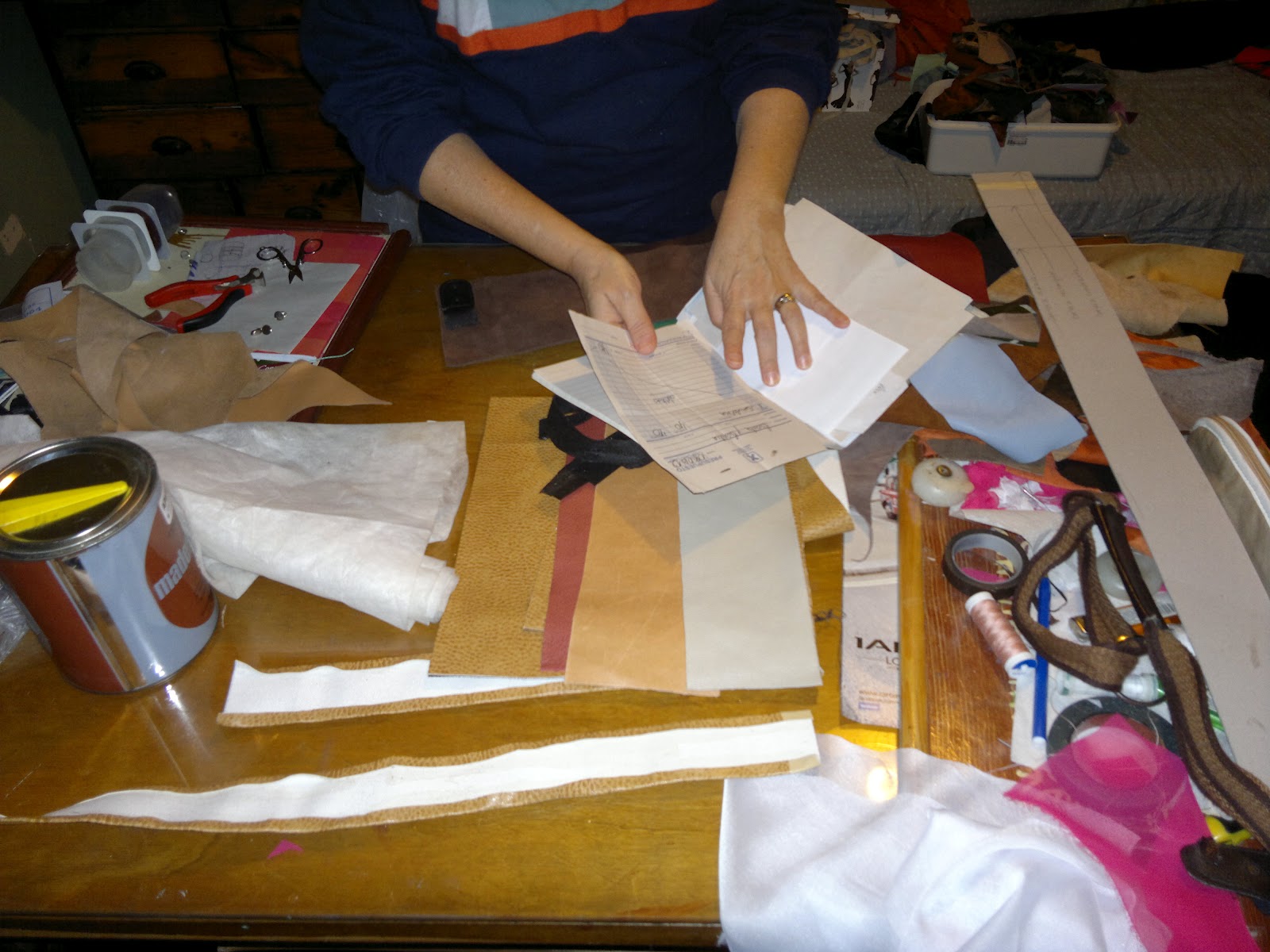
Buen día a todos!!! Disculpen las demoras de actualización pero anduvimos con una semanita muy atareada e inventiva. Pronto se vendrán en esta semana, algunas fotos de nuestros nuevos productos con breves explicaciones de su realización y materiales utilizados. Por hoy, simplemente venimos a mostrarles el momento en que nos encontramos entre telas, cueros y demás elementos y herramientas para la fabricación de nuestras carteras. ¡BIENVENIDOS una vez más!


Good Morning you all! We are so sorry that we didn't uploaded anything during a long time but we had a very exhausting week, which was also really creative. Soon enough this week you will see some photos of new products with brief explanations of the way it was made and all the materials used to make it. 
Today we want you to see the time we meet with the different fabrics, leathers and many other elements and tools of our handbag manufacturing. Once again, WELCOME!  


Y por último, pero no por eso menos importante, queremos compartir con Uds. esta idea para una nueva cartera (foto que está abajo). ¿Qué les parece? ¿Les gusta? ¿Harían algo diferente?

And last but not least, we would love to share with you this new idea for a new handbag (the last photo of the post) What do you think? Do you like it? Would you do something different?


miércoles, 13 de junio de 2012

Cuero / Leather


Tipos de cuero / Kinds Of Leather
El distinto origen, tratamiento de curtido y posterior elaboración del cuero proporciona un producto final muy distinto.

What makes the final product truly different is the origin, the tanned hide procedure and posterior elaboration of the leather. 


Según su procedencia / Regarding the Origin.

Los cueros tienen diferentes tipos según la procedencia de las pieles, y difieren en su estructura según sean las costumbres de vida del animal originario, la edad del animal, el sexo, el semen y la estación  del año en la que fue tratada. La primera categoría podría ser:
- Bovinos
- Caprinos
- Porcinos
- Equinos
- Nutria
- Chinchilla
- Reptiles
- Peces (a veces se emplea la piel de los tiburones)
- Cérvidos (ciervos, gamos o renos)
Leathers are different, depending on the origin of the skin and because of the structure depending on the customs  the living animal used to have, the age of it, the sex, semen and the season of the year in which it was treated the leather. The first category could be:
- Bovine
- Goats
- Pigs
- Equine
- Otter
- Chinchilla
- Reptiles
- Fish (sometimes even shark)
- Cervids

Según su procedimiento de curtido/ Regarding the tanned hide procedure 

Toda la piel tiene que sufrir un proceso de Curtido para que no se pudra y conserve la flexibilidad. Las sustancias que se le aplican para conseguir ese efecto condicionan el resultado final.
All the skin should suffer the tunned hide procedure so they don't rot and maintain the flexibility. The substances used to get that effect are the ones that influence the final result.
Hay que tener en cuenta que estos procedimientos no son excluyentes, a menudo se mezclan los distintos elementos curtientes para obtener un producto final intermedio.
You must have in mind that these procedures aren't exclusives. They are often mixed with the different kinds of tanning elements so you can obtain an intermediate final product.
§  Cuero crudo: No tiene ningún tratamiento químico para su conservación, salvo en ocasiones sal. Si se utiliza sal, lo habitual es hacerlo inmediatamente después de desollar la piel, extendiendo una capa sobre la cara interior y enrollándola sobre sí misma durante varios días. Se descarna la piel , se la lava y se la estira mientras se seca. Es rígido y quebradizo, y principalmente se utiliza para la fabricación de tambores tradicionales, cordeles o juguetes para perro. Un uso tradicional era el empleo de pieles enteras de cabras o conejos, incluso más raramente vacunos, en la fabricación de alfombras. Secando simplemente la piel sobre una superficie lisa, que puede o no contener una capa de sal, se dejaba luego sobre el suelo con el pelo hacia la parte superior.
Crude Leather: it doesn't contain any chemical procedure for it preservation, except some times with some salt. If salt is used, the usual thing is to put it just immediately after you have grown the skin by extending a salt layer on the interior part and rolling it up during several days. While drying, the skin is being washed and stretched. Is rigid and it breaks easily. It's mainly used for the manufacture of traditional trumps, strings or even for dog's toys.  Some goats or even bunnies fur were used in the manufacturing of carpets. They dried the skin on a smooth surface, containing or not a layer of salt, and then was left on the floor with the hairy part looking to the sky.

§  Curtido con sesos: Es un proceso trabajoso que consiste en saturar la piel de aceites emulsionados, a menudo obtenidos a partir de cerebros animales y estirarla mientras se seca, actualmente no se emplea de forma industrial. Las pieles obtenidas por este sistema reciben el nombre de gamuza y son excepcionalmente suaves, flexibles, resistentes al desgaste, absorbentes y pueden lavarse.
Brain Tanning: is a hardworking process which consists on saturating the skin with emulsify oils obtained from animals brains and stretch it while it dries. This process is not being used in an industrial way. The skins obtained by this way receive the name of: chamois and they are extremely soft, flexible, resistant, absorbent and can be washed.  

§  Curtido vegetal: Se curte usando tanino y otros ingredientes de origen vegetal. El resultado es un cuero suave y de color marrón; el tono varía dependiendo de la mezcla de ingredientes empleada en el curtido y del color original de la piel. El tanino se oxida con el aire y la luz, por lo que un cuero curtido con materias vegetales irá oscureciéndose con el tiempo de forma similar a una pieza de madera, solo que más rápidamente. Esto, que puede dar una bonita pátina a algunos objetos de cuero, puede arruinar el teñido en otros. Este tipo de cuero no es estable en el agua, tiende a decolorarse, y si se empapa y se deja luego secar se endurece y se vuelve más áspero y duro. Sometido a alta temperatura, las fibras de colágeno se contraen, se endurece drásticamente y se vuelve rígido y quebradizo. Actualmente ese tipo de curtiduría se destina principalmente a talabartería, cuero para artesanía y como pre-curtido en la curtición por cromo.

Vegetable Tanning:  the process of tanning is based on the tannin and other vegetable ingredients. The result is a soft and brown leather. That brown colour is different depending on the mixture of ingredients used during the process and the original colour of the skin. The tannin goes rusty when it becomes in contact with the air and light, so this kind of leather is going to start growing dark with time in the exact same way as wood but faster. This can have two results: one is that the leather ends up looking good or that the dyeing ruins. This kind of leather isn't stable in water, because it looses its colour and if it gets all wet and then left somewhere to get dry it will only get harsh and rough. If the heat increases a lot, the leather becomes too rigid and will break. This process is mainly used in saddlery, traditional craftwork and pre-tanning in the chrome tanning. 


§  Curtido al alumbre o al aluminio: Se curte usando como ingrediente principal alumbre (una sal de aluminio) Con esta técnica se consigue un cuero muy blanco, pero las pieles curtidas con aluminio se descurten con facilidad en el agua. Tradicionalmente se utilizaba este sistema para la fabricación de pergamino.
Alum or Aluminium Tanning: the main ingredient is the alum (which is an aluminium salt). With this technique you will be able to have a really white leather, but in their contact with some water the tanning fails. Traditionally, this was used to make scrolls.

§  Curtido al cromo: Es el procedimiento más moderno, se inventó en 1858, y el más extendido actualmente. El curtido se realiza utilizando sales y ácidos de cromo. A las piezas de cuero teñidas por este procedimiento se les llama también "cuero azul", por el tono gris-azulado que da al cuero antes del teñido. El cuero obtenido es suave, flexible, resistente al agua (no se mancha ni pierde ni el color o la forma al mojarse), y permite el teñido posterior con toda la gama de colores imaginables. La mayoría de las tenerías trabajan actualmente con este método, y es por el que se obtiene la mayoría del cuero actualmente utilizado para vestimenta y tapicería. Como inconveniente, es el sistema de teñido más contaminante.
Chrome Tanning:  this is the most modern process. It was invented in 1858 and is mostly used nowadays. The tanning is done by using chrome salts and acids. The leather pieces dyed under this process are commonly called "blue leathers" because of the grey-blue tone it has before dyeing it. The leather obtained is flexible, soft, water resistant and allows you to dye it in every colour you like. Most of the tanneries are working with this method and that's why we have clothes and tapestries. The only problem is that this system is one of the most pollutant.  

Según tratamiento post-curtido/ Regarding post-tanning process
§  Cuero cocido: Cuero endurecido por el sistema de introducirlo en agua, cera o grasa hirviendo. Por este procedimiento las fibras decolágeno se acortan, y la pieza de cuero se encoge y se hace rígida y mucho más dura. Si se emplea solamente agua, el resultado es quebradizo, pero si se emplea cera o grasa, esta empapa la pieza y el resultado es mucho más resistente. En los escasos minutos en que la pieza se enfría, resulta muy moldeable, manteniendo después la forma obtenida una vez que se endurece. No todo el cuero curtido sirve para esta práctica, habitualmente se emplea el cuero de curtido vegetal.
Históricamente este procedimiento se empleaba para fabricar armaduras de cuero, pero también se ha utilizado para encuadernaciónde libros o la fabricación de pequeños muebles o cofres. Actualmente se utiliza en artesanía, re creacionismorol en vivo e incluso paraescultura.
Stew leather: the leather is harden by introducing it into the boiling water, wax or fat. In this method the collagen fibers become shorter and the leather piece shrinks and becomes rigid and much more harsh. If you only use water, the result is fragile, but if you use wax or fat the result is much more resistant. In the few minutes the piece get cool, it results malleable and sticks to the shape you gave it. Not every stew leather is able to do it during this process. Vegetable tanning leather is the one that goes perfectly with it. 
Historically, this procedure was used to produce leather armors, for book binding, small furniture or chests. Nowadays is used in traditional craft work and in sculptures. 
§  Cuero engrasado: Cuero engrasado para aumentar su resistencia al agua. Esto repone los aceites naturales que permanecen en el cuero después del proceso de curtido, que se pierden con el uso continuo. Todo el cuero curtido puede recibir tratamiento de grasa, aunque los cueros curtidos con productos naturales, al ser mas porosos absorben mejor la grasa. El engrasado frecuente mantiene el cuero flexible, impide que se vuelva quebradizo y alarga sensiblemente su conservación.
Greasing Leather: this makes the leather much more resistant to water. This process replace the natural oils that remain in the leather after the tanning process which are usually lost in the everyday use. All the tanned leather can receive fat treatment although the one that already gone through the natural product tanning absorb in a better way the fat. The greasing keeps the leather in a flexible way and doesn't allow the leather to become fragile. Besides it longs much more time.  
§  Cuero teñido: Cuero tratado con colorantes para conseguir tonos decorativos. Todos los tipos de curtido se pueden teñir. Para teñir los cueros en artesanía se utilizan tintes de anilina disueltos en alcohol, aplicados con un algodón o tela o bien pinturas acrílicasaplicadas habitualmente con pincel

Dyed Leather: this is the leather exposed to coloring. Every kind of tanning can be dyed. In the case of traditional craft work they use aniline dyes diluted in alcohol. If you use this you can aplly it on the leather with cotton, fabrics or with a paint brush.   
§  Charol: Cuero cubierto con una o varias capas de barniz de poliuretano que le da un brillo característico. Este tratamiento impermeabiliza el cuero y lo hace más resistente.
Patent Leather: leather covered with one or more polyurethane varnish layer. It gives a characteristic bright. This method provides the leather with waterproof and makes it more resistant

sábado, 9 de junio de 2012

Contactenos / Contact Us


Welcome You all!!! How has the weekend been so far? Hope pretty well!! Ours started by working a little bit on Friday, mixing textures, colours, doing some new sketches and more!!! Soon enough you will be enjoying photos of some new work! 

As you well know, we've already given ways for you to contact us... But I'll give that information again so that most people from other countries is able to reach us. 


Bienvenidos a todos!!! Como les está yendo en este fin de semana? Esperamos que todo este excelente!!! El nuestro comenzó con un poco de trabajo el dia Viernes, mezclando texturas colores, creando nuevos diseños y muchísimo mas! Pronto podrán disfrutar de fotos de algunos de nuestros nuevos trabajos!


Como bien saben, ya dimos la información pertinente para que se contacten con nosotras, sin embargo, considero que dicha data debe volver a ser publicada para que muchos de Uds., posibles futuros clientes, puedan contactarnos. 


Mobile Phones - Celulares: 

  • +54 9 341 666 4970 (Cecilia Acevedo)
  • +54 9 341 323 7629 (Carla Demaria)


 E-mail:
perleaccesorios@hotmail.com


Well, that's all for today but remember to be checking on us pretty soon because not only photos of our new products are coming to the stage, but also the explanation of the techniques we use on our handbags!!! You will be able to read about the fabrics we use and the colours this season are being used in our country Argentina, and in the near future how we are trying to adapt the flowered print with the animal print and also the dots and stripped prints all together so that most of the people in our country get used to them in fashion as well in many other countries around the world did. 

See you around!! and continue enjoying your weekend!!!

Love, Perle.


Bueno, eso es todo por hoy, pero recuerden chequear en nuestras páginas y twitter muy pronto porque no solo subirán a este escenario fotos de nuestros nuevos productos, sino que además encontraran las explicaciones acerca de las técnicas que utilizamos en nuestras carteras! Podrán leer sobre las telas y demás accesorios que utilizamos asi como los colores que esta temporada se utilizan en Argentina y en un futuro cercano como estamos tratando de adaptar los estampados floreados, animal print y de puntos y a rayas en un conjunto para que la mayor parte de nuestros clientes de Argentina se adapten a la moda que ya está  marcada en otros países de alrededor del mundo. 


Hasta pronto y sigan disfrutando de su fin de semana!!!

Los quiere, Perle.


jueves, 7 de junio de 2012

Algunos de Nuestros Productos / Some of Our Products I

1. Brown PU handbag with stamped micro corduroy the stripes made with brown leather (Cartera telada de PU color suela con micro corderoy estampado las tiras hechas de cuero marron) 
 2. PU Animal print handbag with red leather stripes (cartera de PU animal print color suela con tiras rojas de cuero)
 3. Handbags made with the patchwork style with different leathers (Carteras hechas al estilo patchwork con diferentes cueros)
 4. Handbag with appliqué with leather and metal ornaments (Cartera con aplicados hechos de cuero y tachas)
 5. PU Animal print handbag with brown leather strips (Cartera PU de animal print con tiras marrones de cuero)
6.  Handbag with appliqué of leather and metal ornaments (Cartera con aplicados en cuero y tachas)
 7. PU Animal print handbag with black leather strips (Cartera PU de animal print con tiras negras de cuero)
 8. Black leather handbag with stamped fabric (Cartera de cuero negra con tela estampada) 
 9. PU Brown handbag with a technique called "Fajada" which consists on those different types of leathers with different textures (cartera PU color suela  con una tecnica llamada "fajada" que consiste en aplicarle diferentes tipos de cueros con diferentes texturas)
 10. PU Black Handbag with  zip and tessel (Cartera de PU negra con cierre y borla)
 11. Handbags made with the patchwork style with different kinds of leather (Carteras hechas al estilo patchwork con diferentes cueros)

  12. Grey handbag with a red leather flower (Cartera gris con flor de cuero roja)
13. Black handbag with peace symbol and metal ornaments. With golden leather details as well (including the peace symbol) (Cartera negra con el simbolo de la paz y tachas [ornamentos de metal] Detalles de cuero en dorado como el simbolo de la paz.)


Todas nuestras carteras tienen detalles en cuero incluyendo nuestro logo de marca.

All our handbags have leather details, including our brand logo.


Saludos, Perle.

Your Faithfully, Perle.